Address
304 North Cardinal St.
Dorchester Center, MA 02124
Work Hours
Monday to Friday: 7AM - 7PM
Weekend: 10AM - 5PM

Address
304 North Cardinal St.
Dorchester Center, MA 02124
Work Hours
Monday to Friday: 7AM - 7PM
Weekend: 10AM - 5PM

 Byadmin
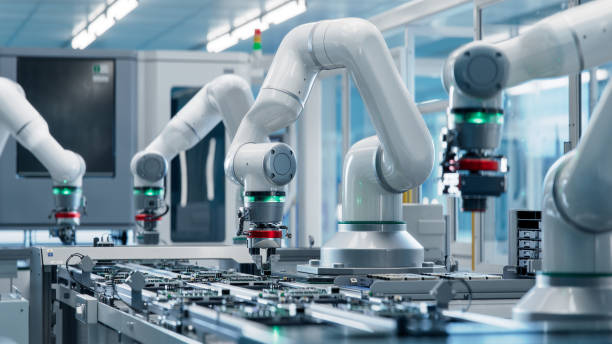
Robotic technology has revolutionized advanced manufacturing, transforming traditional production processes by enhancing efficiency, precision, and flexibility. Robots are automating labor-intensive and error-prone tasks, playing a critical role in assembly, welding, material handling, and quality control. These advanced robots, equipped with sensors and AI capabilities, are reshaping how products are made.
The global robotics market is expected to grow from USD 37.81 billion in 2017 to USD 158.21 billion by 2025. The growing adoption of robotics across industries such as defense, manufacturing, automotive, healthcare, and electronics is driving this expansion. Key factors include the rise of Industry 4.0, the need for skilled workers, safety concerns, and the demand for higher-quality products and services.
Revolutionizing Production Processes
Automation of Repetitive Tasks: Robots excel at repetitive, precise movements, reducing human errors and improving product quality.
Increased Production Speed: Robots work tirelessly, increasing production speed, throughput, and reducing lead times.
Enhanced Precision and Consistency: Robots maintain accuracy and consistency, ensuring uniform product quality and fewer defects.
Complex Assembly and Manufacturing: Advanced robots with vision systems and AI tackle intricate assembly tasks previously challenging for humans.
Flexible Manufacturing: Robots can be easily reprogrammed, enabling manufacturers to quickly adapt to changing demands and produce various products.
Inadequate Teacher Training: Teachers, especially in STEM subjects, require continuous professional development to stay updated on emerging technologies and modern teaching methodologies.
Lack of Innovation and Research Focus: The current education system often stifles creativity by prioritizing rote memorization over problem-solving. Cultivating a mindset of innovation and research from a young age can inspire students to pursue careers in manufacturing.
Impact on Industries
Automotive Industry: Robots handle tasks like welding, painting, and assembly, improving efficiency and precision in large-scale production.
Electronics Industry: Robotics is crucial for tasks like surface mount technology (SMT) and PCB assembly, where precision and speed are vital.
Pharmaceutical Industry: Robotic systems ensure accurate dispensing, labeling, and packaging, minimizing errors and ensuring compliance.
Food and Beverage Industry: Robots automate sorting, packaging, and palletizing, improving efficiency and hygiene.
Aerospace Industry: Robots assist in assembling complex components, reducing production time and increasing accuracy.
Consumer Goods Industry: Robotics streamline packaging, labeling, and quality inspection, optimizing production.
Robotics in advanced manufacturing continues to enhance productivity and transform industries by automating tasks, ensuring quality, and enabling faster, more flexible production processes.