Address
304 North Cardinal St.
Dorchester Center, MA 02124
Work Hours
Monday to Friday: 7AM - 7PM
Weekend: 10AM - 5PM

Address
304 North Cardinal St.
Dorchester Center, MA 02124
Work Hours
Monday to Friday: 7AM - 7PM
Weekend: 10AM - 5PM
 Byadmin
3D printing, or additive manufacturing, is a transformative technology reshaping the manufacturing industry. Unlike subtractive methods, it builds objects layer by layer, allowing for greater design flexibility and customization. This innovation enables the creation of complex geometries and intricate structures while reducing material waste and production timelines. It has revolutionized prototyping, design, and manufacturing, offering unparalleled efficiency and personalization.
Applications of 3D Printing
Prototyping and Rapid Iteration: Speeds up product development by enabling the quick creation and testing of prototypes, refining designs efficiently.
Customization and Personalization: Produces tailored, unique products, including patient-specific medical implants and devices in healthcare.
Manufacturing Tooling: Creates jigs, fixtures, molds, and tooling faster and more cost-effectively than traditional methods.
Aerospace and Automotive: Fabricates lightweight, intricate parts with superior performance for aerospace and automotive industries.
Medical and Dental: Develops anatomical models for surgical planning, patient-specific implants, and custom prosthetics.
Benefits of 3D Printing
Design Freedom: Enables intricate and complex designs that are difficult or impossible to achieve with traditional methods.
Reduced Waste: Minimizes material wastage by building objects layer by layer, contributing to eco-friendly manufacturing.
Rapid Prototyping: Speeds up product development by quickly producing and testing prototypes.
Customization: Facilitates the creation of tailored products to meet unique individual needs.
On-Demand Production: Supports localized and on-demand manufacturing, reducing inventory costs and streamlining supply chains.
3D printing is a game-changing technology reshaping industries by revolutionizing product design, prototyping, and manufacturing. Its strengths lie in enabling customization, minimizing waste, and driving innovation. As advancements unfold, tackling its challenges and unlocking new possibilities will further enhance its impact on modern manufacturing.
Advantages of Integrating 3D Printing in Education:
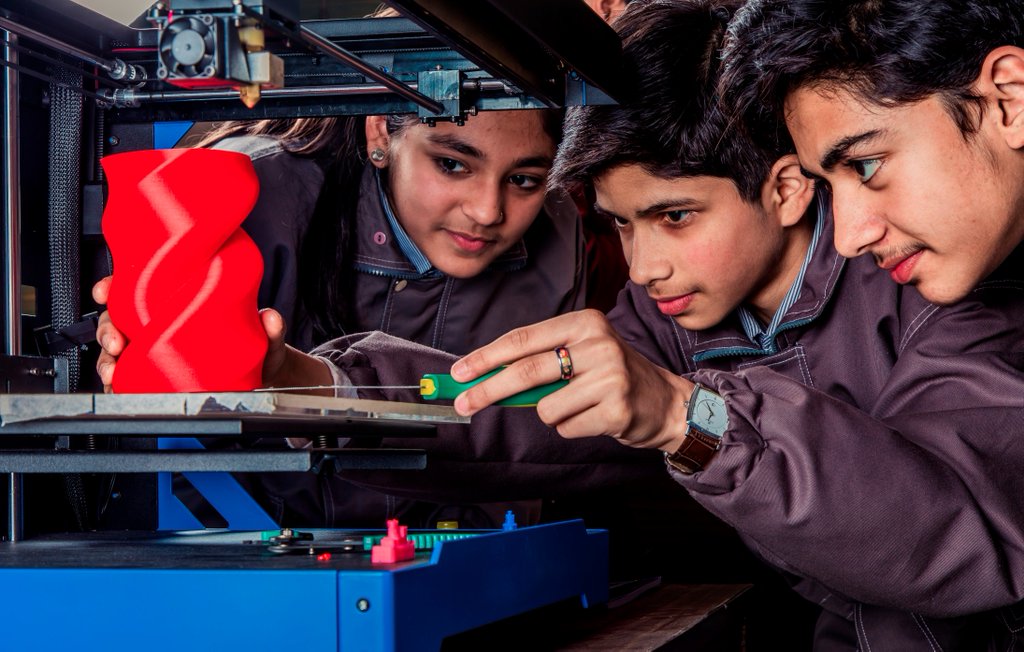
Empowering Student Innovation: 3D printing turns students into creators, not just consumers. It encourages them to identify problems and design solutions. For example, a school nature play area was designed by students using Makers Empire and built by landscapers. Similarly, William Graeme, a diabetic, invented a sanitary device for used blood testing strips. With the right tools, students can create amazing innovations!
Bringing Art Back: 3D printing boosts the comeback of art in education, blending creativity with cutting-edge technology. Students become designers, enhancing spatial reasoning and 2D-to-3D conversion skills, key predictors of future success.
Engaging Reluctant Learners: 3D printing captivates even reluctant learners, offering an interactive and tangible approach to education.
Creating Responsible Digital Citizens: Students become part of the growing 3D printing community, fostering responsible digital citizenship.
Hands-On Learning: With 3D printing, students can create models that bring lessons to life—whether it’s ancient civilizations, landforms, or natural disaster solutions.
Building School Camaraderie: Collaborative 3D printing projects promote teamwork and camaraderie within schools.
Solving Real World Problems: By tackling community challenges with 3D printing, students develop empathy, teamwork, and problem-solving skills.
3D printing is a game-changer, offering a mini manufacturing plant and prototyping tool right within the school. It allows students (and teachers!) to bring their imaginations to life. Give them the transformative opportunity to discover the incredible things they can create with this powerful technology.